
Reviewed · COASTEERING ADVENTURES
Coasteering Hele Bay Adrenaline Adventure
Hele Bay coasteering turns a normal coastline walk into pure momentum, guided and safety minded. I love the real adrenaline of progressing jumps from about 3 feet up to 33 feet, and I love how the route mixes swimming through gullies with short rock crossings along the cliff base. The one drawback is simple: if you hate heights or you are not fully comfortable in the water, this is not the kind of activity you can fake.
The guides really shape the experience, and in this one I’m paying attention to Zac and Joe. After a safety briefing and gear check, you start with a sea swim, then you climb and jump with options the whole time, so you are not forced to do more than you can handle. Just know you will get wet, and this is weather dependent, so plan for sea state and wind to steer the day.
In This Review
- Key Points You’ll Feel Immediately
- Entering Hele Bay Mode: Meeting the Coastal Adventures Van
- Gear and Safety Briefing: The Stuff You Don’t Want to Skip
- From Sea Swim to Cliff Base: What Happens After You Gear Up
- Jumping That Progresses from 3 to 33 Feet
- The Washing Machine Area and Rock Acrossings
- The Wales Across-the-Channel Factor
- Timing: How the 2.5 Hours in Water Fits a 3-Hour Trip
- Price and Value: Is $75 Worth It?
- What to Bring to Stay Comfortable (and Not Miserable)
- Who Should Join, and Who Should Skip This
- Should You Book Coasteering at Hele Bay?
- FAQ
- How long is the coasteering experience at Hele Bay?
- What should I bring, and what footwear works best?
- What jump heights can I expect?
- Is this safe if I am not a strong swimmer or I get scared of heights?
- What should I wear and do I need gloves?
- Is there a refund if I cancel?
Key Points You’ll Feel Immediately
- 3 to 33 foot jumps with gradual progress, plus an option not to jump as high
- Wavey gullies and rock boulders, so you move with the coastline, not just swim in a straight line
- A classic coasteering session style, about 2 hours in the water with 2.5 to 3 hours total from arrival to departure
- Wales visibility on clear days, including the Pembrokeshire Coast across the channel
- A guided, safety-first setup with high-quality safety tested equipment
- Expect the fun chaos of the washing machine area, where water churn makes everything feel faster
Entering Hele Bay Mode: Meeting the Coastal Adventures Van
This is the kind of adventure that starts before you touch the water. You meet at the Coastal Adventures Ltd van at Hele Bay, which keeps things tidy and easy to find compared to scattered meeting points. Once you arrive, the first thing you should do is tell your guide how comfortable you are with swimming, heights, and getting soaked. That quick conversation helps them decide how to pace you.
You are in South West England, near Ilfracombe, and the setting matters. Hele Bay is all about that rugged cliff base that turns into natural pathways when you are in the water. Even before you go anywhere near the jumps, you’ll understand why coasteering here feels more like a route along the coast than a one-note thrill ride.
The session is run in English with professional, fully qualified guides. You’ll also hear the day’s flow: safety briefing, equipment, then getting to the deep water drop-offs.
More sea-level scrambles round the headland:
- Newquay: Coasteering
★ 4.9 · 21 reviews - Pembrokeshire: Coasteering Adventure at Stackpole Quay
★ 5.0 · 6 reviews - Tenby: Coasteering Adventure
★ 5.0 · 5 reviews
Gear and Safety Briefing: The Stuff You Don’t Want to Skip
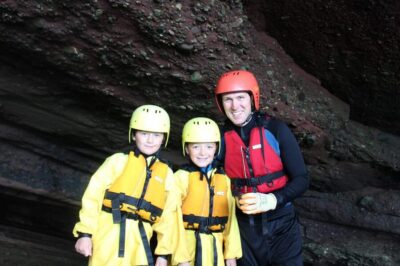
Coasteering is not a DIY sport, and the value here is that you are not improvising. You get all the quality safety tested equipment you need, which is exactly what you want when you’re dealing with waves, rocks, and jumps. If you request them on booking, you can also get gloves to protect your hands, which is a small detail that can make a big difference when you’re climbing and grabbing rock edges.
Before anything fun happens, you get a safety briefing. Pay attention here, even if you came for the jumps. The briefing is where you learn how the guide expects you to move, when you jump, and how they’ll manage group spacing around water churn. Good technique keeps you safe and keeps the day flowing.
You’re also told what to bring. At minimum, plan on swimwear and a towel. And yes, you should dress expecting to get wet. There’s no changing that, so treat it like part of the plan.
From Sea Swim to Cliff Base: What Happens After You Gear Up
After the briefing and equipment check, you head toward the water and the first part of your session. You start with a sea swim and marine life viewing along the way, then the day turns into a mix of movement modes: swimming, climbing, and jumping.
This is one of the smartest parts of the experience, because it warms you up without immediately throwing you into the deep end. A sea swim helps you get used to the water temperature, the pull and push of the waves, and how your body feels when you are not on flat ground. If you’re the nervous type, this is where you can settle in and learn the rhythm.
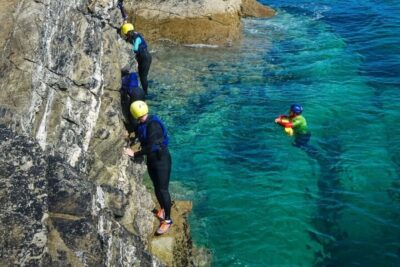
Then you transition to the cliff base route, where you’ll work your way along coves and along rock faces. This is where coasteering turns from swimming into navigation. You’re not just following a beach. You are moving in and around the coastline’s shapes, using the rock base as your route.
Jumping That Progresses from 3 to 33 Feet
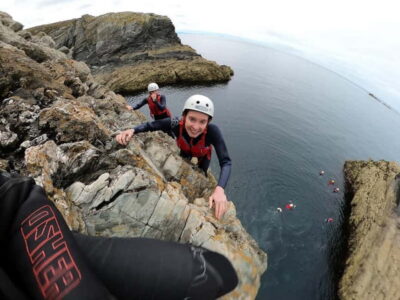
Let’s talk about the part you came for. You will leap from rocks with jump heights ranging from 3 to 33 feet. What makes this better than a single jump stunt is the gradual progression. The guide can build your confidence step by step so the day feels like a climb in difficulty, not a sudden shock.
Here’s what I like about this structure: it gives you a mental on-ramp. Even if you are excited, you still need time to feel how the landing works, how your body reacts to the drop, and how the water immediately changes your pace. The guide’s pacing is also where you get control. There are options not to jump if you don’t want to, so you can keep participating without pushing your limits beyond what you’re comfortable with.
If you’re afraid of heights, do not treat this as a maybe. The activity is clearly not suitable if heights scare you. Coasteering uses cliffs and exposure as part of the route, so your fear will affect how you move and decide.
A page further on, still in London:
- London: The London Eye Entry Ticket★ 4.6 · 35,875 reviews
- From London: Harry Potter Warner Bros Studio Tour★ 4.7 · 26,588 reviews
- London: Westminster to Greenwich River Thames Cruise★ 4.5 · 22,836 reviews
- Magical London: Harry Potter Guided Walking Tour★ 4.7 · 22,044 reviews
The Washing Machine Area and Rock Acrossings
At Hele Bay, you’ll spend time in what coasteering people often describe as the washing machine area. Translation: water that churns and pulls more aggressively than the calmer sections. It’s called fun because it creates that feeling of being in motion, like the sea is helping you along instead of just sitting there.
You’ll jump, then swim in these churning zones and wavey gullies. You’ll also do boulder crossings across rock faces. This part is about balance and timing. The goal is not to muscle through it. You move because you know where your footing is, where your route is, and when to let the next wave moment help you.
The practical takeaway for you: keep your grip and keep your head. Don’t fight the water. Let the guide’s instruction guide you, and focus on the next move rather than the whole distance. Coasteering rewards people who stay calm and methodical even while they’re having a good scare.
The Wales Across-the-Channel Factor
One of the quiet perks of this Hele Bay adventure is the view line. On clear days, you can see across to Wales, including the Pembrokeshire Coast. That matters more than it sounds, because it changes how you experience the route. You’re not just looking at water. You’re getting that sense that the coastline stretches beyond your immediate horizon.
When you’re doing jumps and climbing, your brain tends to go tunnel vision. Having a far-away landmark like Wales helps you reorient. It also makes photos make sense because there’s enough scale in the scene, cliffs, coves, and that long channel view.
Timing: How the 2.5 Hours in Water Fits a 3-Hour Trip
The total experience is about 3 hours, with 2.5 hours of coasteering and around 2 hours in the water. Arrival to departure usually lands in the 2.5 to 3 hour range, depending on the day and conditions.
This timing is practical for planning. You’re not committing to a full half-day that eats your entire afternoon. You also get enough water time to actually feel like you did a proper session, not a quick splash and a thumbs up.
Be ready for the schedule to flex slightly, because coasteering is weather dependent. If the sea is choppy, you might spend more time focused on safety and smooth transitions rather than pushing the higher jumps right away. That’s normal. What you want is a guide who adapts and keeps the group safe.
Price and Value: Is $75 Worth It?
At $75 per person, you’re paying for more than the thrill. You’re paying for:
- Safety tested equipment supplied for you
- A guided route with professional, fully qualified staff
- A structured session that includes safety briefing, sea swim, climbing, and progression jumps
- Time on the water, about 2 hours, in a place that naturally supports coasteering
So is it value? In my view, it is, because the expensive part of this activity is the risk management. Equipment and qualified guides are not extras here. They are the core product. If you were to do something like this on your own, you’d lose the safety framework, the instruction, and the pacing that makes the experience enjoyable instead of chaotic.
Also, the pricing lines up with a short, high-impact adventure where you get real effort and real fun in one go. You’re not paying for sightseeing in a vehicle. You’re paying for guided action on the coast.
What to Bring to Stay Comfortable (and Not Miserable)
Coasteering gear can feel annoying until you realize how much it affects your day. Plan for wet conditions and rock contact. The basics are:
- Swimwear
- Towel
Footwear is where most people either get it right or regret it. You should bring old trainers or similar footwear you do not mind getting wet. Beach shoes are not suitable. If you’re thinking about slick sandals, don’t. Your feet need to work on wet rocks.
If you booked gloves, you’re covered on hand protection. If you didn’t, still protect your hands with whatever the guide suggests during the briefing. It’s one of those small costs that prevent small injuries, and it keeps you climbing comfortably instead of worrying about your grip.
For food and drink, it is not included, but there’s a local cafe on the beach front. That’s handy after you dry off and want something warm.
Parking isn’t included either. You may need small change for parking, listed as £2.50 all day, or you can use Ringo. Either way, check what makes sense so you’re not rushing at the last minute.
Who Should Join, and Who Should Skip This
This activity is clearly built for people who are comfortable in water and looking for an adrenaline edge. It is perfect for adventurous participants who can handle heights to a degree, can follow instructions, and are willing to get wet.
It is not suitable for:
- Children under 8 years
- People with mobility impairments
- People afraid of heights
- Non-swimmers
- Visually impaired people
- People over 70 years
If you’re on the fence because you think you are brave but you’re not sure about heights, be honest. Coasteering uses real cliff exposure and real jumps, even with options. If heights scare you, this can become stressful fast, and stress is the opposite of what makes it fun.
If you are a strong swimmer but new to rocks, you’ll still get a structured progression. The guide controls that.
Should You Book Coasteering at Hele Bay?
Book this if you want a short, high-energy coastal adventure in South West England. You’ll enjoy it most if you like doing more than just watching the sea, you can swim comfortably, and you want that mix of jumps, scrambling, and wavey gullies under professional supervision.
Skip it if you are not comfortable in water, if heights are a big fear, or if you fall into any of the listed unsuitability categories. In those cases, the safety and the route will likely overwhelm you.
If you do go, my practical advice is to show up mentally ready for wet gear, old trainers, and a day that can adjust with the sea. Zac and Joe’s approach, from what you can expect from this kind of day, is about keeping the group moving and giving you choices. That’s the kind of guide you want when the ocean is calling the shots.
FAQ
How long is the coasteering experience at Hele Bay?
The total experience is about 3 hours. You get around 2.5 hours of coasteering time, with about 2 hours in the water.
What should I bring, and what footwear works best?
Bring swimwear and a towel. Wear old trainers or similar footwear that you do not mind getting wet. Beach shoes are not suitable.
What jump heights can I expect?
Jumps range from about 3 feet up to 33 feet. The jumps progress gradually, and there is always an option not to jump if you do not want to.
Is this safe if I am not a strong swimmer or I get scared of heights?
It is not suitable for non-swimmers or for people afraid of heights. The activity expects participants to be comfortable in the water.
What should I wear and do I need gloves?
Swimwear is required. Gloves may be provided if you request them when booking, and you should also expect to get wet. Old trainers are recommended for your feet.
Is there a refund if I cancel?
Yes. You can cancel up to 24 hours in advance for a full refund.
Newest entries under London






Coasteering Adventures, compared.
Pembrokeshire: Coasteering Adventure at Stackpole Quay
Read our review →
North Wales: Extreme Coasteering with Cliff Climbing & Jumps
Read our review →Browse the lists this tour appears in