
Reviewed · MUSEUMS
London: British Museum Private Guided Tour
Big museum, small-time plan. This private British Museum tour makes the most of your time, with a guide-led run to Rosetta Stone and the Great Court, and it gives you space for questions instead of crowd chaos. I love how the route hits the heavy hitters without wasting steps, and I love that your guide actually answers what you ask. One thing to consider: two hours goes fast, so you will want to focus on your top picks.
You are looking at a place that covers 2 million years across six continents, with about 8 million objects total. In a tight, private format, you see standout works tied to Ancient Egypt, Rome, Saxons, and Vikings, plus the bigger story of the British Empire and how it shaped what ended up in the museum.
You meet at the Edward VII entrance, the rear entrance in Montague Place. The guide contacts you by WhatsApp message with identifying details, the tour runs in English, and the museum rules mean no flash photography and no luggage or large bags (and no backpacks), so wear comfy shoes and travel light.
In This Review
- Key highlights worth planning for
- Where the British Museum tour starts, and how to keep it smooth
- The first big payoff: a two-hour route through museum scale
- Rosetta Stone and Ancient Egypt: the moment you see the decoding tool
- Parthenon Marbles: why Greek sculpture still sparks big debates
- Hoa Hakananai’a (Easter Island statue): a Pacific story in a London hall
- Viking Lewis Chessmen and Anglo-Saxon Sutton Hoo: crafts, power, and clues
- The British Empire thread: why it matters for what you see
- Great Court and the Reading Room: where the building becomes part of the story
- Ending strong: personalized recommendations and dining ideas
- Price and value for $263 per group (up to 8 people)
- Who should book this private British Museum tour
- Should you book it, or plan it on your own?
- FAQ
- How long is the British Museum private guided tour?
- What is the price for the tour, and how many people are included?
- Where do we meet for the tour?
- What artifacts are included in the highlights?
- Is the tour private?
- What are the rules on photos and bags?
- Is the tour wheelchair accessible?
- What do you get at the end of the tour?
Key highlights worth planning for
- A private guide for up to 8 people so you can ask questions and move at your pace.
- Iconic objects in one visit including the Rosetta Stone, Parthenon Marbles, Hoa Hakananai’a, Lewis Chessmen, and the Sutton Hoo ship burial.
- British Empire context built into the stories, not tacked on at the end.
- Great Court time at the largest covered square in Europe, with a good moment to reset.
- Personal recommendations after the tour, plus advice on local dining to round out your day.
Where the British Museum tour starts, and how to keep it smooth
This tour starts at the Edward VII entrance in Montague Place, using the rear entrance for the British Museum. You will get a WhatsApp message from your guide with a description so you can find each other quickly. That small step matters because the museum sits right in a busy London area, and you do not want to burn your first minutes looking for the meeting spot.
For the visit itself, you are in a private group set-up, not a big cattle-car situation. The big benefit is control. If you stop to read something, the pace does not instantly punish you. If your brain is craving structure, your guide can steer you to the next must-see.
Do keep the museum rules in mind. Flash photography is not allowed, and you should not bring luggage or large bags, and backpacks are also not allowed. If you have ever done museum security in London, you already know how much easier it is when you show up with a light bag and a clear plan.
More Museum Tours in London
- London: Chelsea Football Club Stadium and Museum Tour
★ 4.8 · 4,576 reviews - London: British Museum Guided Tour
★ 4.3 · 1,182 reviews - London: British Museum Guided Tour with Entrance Tickets
★ 4.9 · 748 reviews
The first big payoff: a two-hour route through museum scale
The British Museum can feel like a universe, because it holds 8 million objects across thousands of years. On a normal visit, you pick a few rooms and call it a day. On this private tour, you get a guided path through key eras, with time placed where the most famous objects are.
That is the real value of a time-limited tour here. Instead of trying to figure out where the Rosetta Stone sits relative to everything else, your guide does the sequencing for you. The pacing is built for understanding, not just checklists. You learn the museum’s founding story and how it became a public national museum, then you connect individual objects to the larger themes behind the collection.
A practical note: because this is only 2 hours, you will not cover everything. That is not a flaw, it is a design choice. If you love museums for slow wandering, you can still do that after the tour. But if you want the “I get it now” experience fast, the tight format helps.
Rosetta Stone and Ancient Egypt: the moment you see the decoding tool
Even if you only know the headline, the Rosetta Stone is the kind of object your brain latches onto right away. Here, you see it as the key to deciphering ancient Egyptian hieroglyphs. That framing matters, because you are not just staring at a famous artifact. You are seeing why it matters for reading an entire writing system.
On a private tour, you can spend time noticing what your guide points out, and you can ask questions without feeling rushed. That is one reason this format is worth it at the British Museum. Egyptian history is deep, and most people leave confused because they do not know where to start. The Rosetta Stone gives you an anchor.
If you love language and how discoveries change knowledge, you will appreciate the guide’s emphasis on the story of discovery and the role of key finds in building museum understanding. Even in a short visit, that context turns the object from a photo spot into a meaning-rich stop.
Parthenon Marbles: why Greek sculpture still sparks big debates
Next up, you get the Parthenon Marbles from Ancient Greece. The tour treats them as more than a famous set of sculptures. You learn how they fit into the museum’s larger narrative, including the role of the British Empire in how the museum’s collection was created.
This is a stop where the private format helps. The Parthenon Marbles are iconic, but the real takeaway is how objects move through history and how museums interpret them. Your guide can connect what you are seeing to the broader historical forces that brought such pieces to London and into the museum’s story.
You might also find the tour’s “how it was found” angle useful here. The museum is full of objects whose routes to display involve exploration, tomb raiding, and the spoils of war, and the tour’s storytelling is designed to help you understand those routes without getting lost in facts.
More gallery rooms between showers:
- London: Tour of the British Museum★ 4.1 · 678 reviews
- Afternoon Tea at the British Museum★ 4.2 · 511 reviews
- London: Paradox Museum Entry Ticket★ 3.9 · 441 reviews
- London: National Gallery Guided Tour with Art Expert Guide★ 4.7 · 440 reviews
Hoa Hakananai’a (Easter Island statue): a Pacific story in a London hall
The Easter Island statue, Hoa Hakananai’a, comes next, and it is a great reminder that the British Museum is not just a Europe collection. You see it as a mysterious relic from a remote Pacific context, which gives you a very different kind of cultural encounter than the Roman and Greek galleries.
For me, the value of this stop is perspective. It helps you realize the museum’s scale across continents, because the tour is not just marching through one region. You are moving time and geography in a way that would be difficult to do well on your own in two hours.
You will also appreciate how the guide handles the storytelling. The objects you see are famous, but their backstories are not always obvious. When you have a guide who can explain why an artifact is significant, you leave the room with actual comprehension, not just souvenirs of impressive images.
Viking Lewis Chessmen and Anglo-Saxon Sutton Hoo: crafts, power, and clues
The tour continues with two favorites for people who like objects that feel hands-on, not just monumental.
First are the Lewis Chessmen, described here as intricately carved Viking-era chess pieces from the 12th century. It is a compelling pairing with the museum’s other highlights because it shows a different side of history. You get the sense of everyday play mixed with high skill craftsmanship, and your guide can connect why such objects end up in a museum collection.
Then you see the Sutton Hoo ship burial, presented as a stunning Anglo-Saxon royal treasure hoard. This is where “power and prestige” hits you visually. And because the tour includes the museum’s founding and how collections were built, you are not just learning about the Anglo-Saxon past. You are learning how later history affected what survived, what was found, and how it ended up being displayed for a public audience.
A useful way to think about these two stops is contrast. The chessmen help you imagine culture through a small game object made with care. Sutton Hoo pushes you into the scale of royal burial wealth. Together, they show the museum’s strength: you get to compare civilizations and everyday artifacts and major ceremonial finds in one guided sweep.
The British Empire thread: why it matters for what you see
One of the more important parts of this tour is how it explicitly covers the British Empire and its impact on the museum’s collection. This is not presented as an abstract history lesson. It is tied to the objects and their discovery stories.
If you care about museum ethics and provenance, this is a strong reason to choose a private guide. You can ask direct questions, and the guide can help you connect the dots between imperial-era collection practices and today’s museum experience. Even if you already know some background, hearing it positioned alongside the artifacts makes it more concrete.
You also learn how the British Museum was founded and how it became the first public national museum. That context helps you understand why the collection is so wide and why the display strategy is built around collecting and categorizing human history across eras.
And because the tour also mentions how objects were brought to light through heroic explorations, medieval tomb raiding, or the spoils of war, you get the human angle behind museum highlights. You are not just absorbing dates. You are learning the messy routes that bring artifacts to glass cases.
Great Court and the Reading Room: where the building becomes part of the story
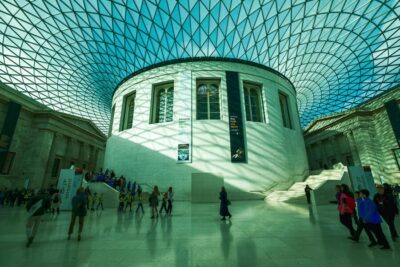
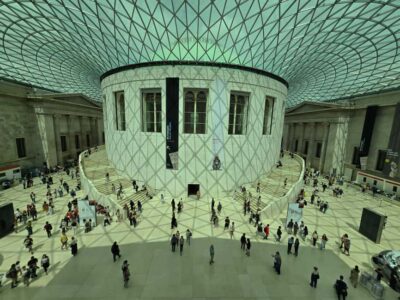
The tour includes time in the Great Court, which is the largest covered square in Europe. This stop is not only for photos, it is for resetting. After multiple galleries, you get a breathing space where you can look up, take in the architecture, and let the earlier stories settle.
If you like “how buildings shape experience,” this is worth your attention. A museum’s physical design affects how you remember what you saw. In the Great Court, you get a sense of how the museum functions like a hub, not just a series of separate rooms.
The tour also references the original British Museum Reading Room as a key research area in the past. That detail matters because it signals the museum’s role beyond public viewing. It is also a place for study, interpretation, and scholarship, which helps explain how guides can connect artifacts to broader themes rather than treating each object like an isolated trophy.
Ending strong: personalized recommendations and dining ideas
At the end of the tour, you receive personalised recommendations on other artifacts to explore. You also get advice on local dining options to finish your British Museum day.
This is a smart feature because it extends the value of a short visit. You leave with direction, not just a memory of highlights. If you tell your guide what you enjoy, you can follow that with a self-guided walk where you already know what to target.
Two hours can only do so much at a museum this big. The recommendation step helps you avoid the common problem of spending your remaining time drifting without a plan.
Price and value for $263 per group (up to 8 people)
The price is $263 per group for up to 8 people, with a 2-hour guided highlight tour. That pricing is the main reason this can be a great deal for small groups.
Think in terms of cost sharing. If you are traveling as a pair or a family, you are often paying close to what it would cost for two separate tickets to a “premium” experience, but you are getting a private guide for the entire group. And because the British Museum is huge, the guide’s time can prevent you from wasting time on the wrong rooms.
This tour is best value if you:
- Want to see specific headline objects like the Rosetta Stone, Parthenon Marbles, and Lewis Chessmen.
- Prefer a private format so you can ask questions and spend time where you care.
- Are short on time in London and want a clear plan rather than museum guesswork.
It may not be the best match if you are the type who likes a long, open-ended museum day. This is a structured 2-hour experience. You can still return later to linger, but the tour itself is designed for focused highlights.
Who should book this private British Museum tour
This tour fits best if you want a guided “greatest hits” path with context. It is a good option for:
- Couples and small families who want the museum highlights without getting overwhelmed.
- People who like object-centered history, especially around Ancient Egypt, Greece, Viking-era artifacts, and Anglo-Saxon treasures.
- Anyone who wants the British Empire connection explained alongside what they are actually seeing.
The guide-led format is also helpful if you want accessibility in planning. The tour is wheelchair accessible, and the private group setup can make movement feel less stressful than navigating a large open crowd.
Should you book it, or plan it on your own?
If your goal is to leave the British Museum feeling like you understood the key stories behind famous objects, I think this is a solid booking. The biggest strengths are the short-but-focused 2-hour route, the chance to ask questions in a private setting, and the fact that the tour connects artifacts to how the museum was built and filled.
Skip it only if you have a full day to spend and you strongly prefer self-guided wandering with zero structure. In that case, you can certainly do the British Museum on your own, but you will trade away the time-saving sequencing and the context your guide provides.
FAQ
How long is the British Museum private guided tour?
The tour lasts 2 hours.
What is the price for the tour, and how many people are included?
It costs $263 per group for up to 8 people.
Where do we meet for the tour?
Meet at the Edward VII entrance, the rear entrance for the British Museum in Montague Place, London.
What artifacts are included in the highlights?
The tour includes viewing highlights such as the Rosetta Stone, Easter Island statue (Hoa Hakananai’a), Parthenon Marbles, Lewis Chessmen, Sutton Hoo ship burial, and more.
Is the tour private?
Yes, it is a private group experience.
What are the rules on photos and bags?
Flash photography is not allowed. Luggage or large bags and backpacks are not allowed.
Is the tour wheelchair accessible?
Yes, the tour is wheelchair accessible.
What do you get at the end of the tour?
You get personalised recommendations on other artifacts to explore and advice on local dining options.
Newest entries under London





Museums, compared.
Tower of London and Crown Jewels Exhibition Ticket
Read our review →
Liverpool Football Club Museum and Stadium Tour
Read our review →
Chelsea Football Club Stadium and Museum Tour
Read our review →

British Museum Guided Tour with Entrance Tickets
Read our review →Browse the lists this tour appears in